Key Points
- Chie Takahashi, founder of the fair trade brand “Kakehashi,” is leading a crowdfunding campaign to establish a dedicated studio for Palestinian designer Aisha in Nablus, West Bank.
- Aisha creates unique fashion and home goods by upcycling high-quality fabric scraps from local furniture and clothing factories, combined with traditional Palestinian embroidery.
- The project highlights the severe economic and psychological toll of the ongoing military occupation, where checkpoints can turn a one-hour commute into a 12-hour ordeal, stifling local production.
- The campaign aims to provide a stable workspace for Aisha to sustain her business and create employment opportunities for other women in her community despite the escalating conflict.
Full Transcript (English)
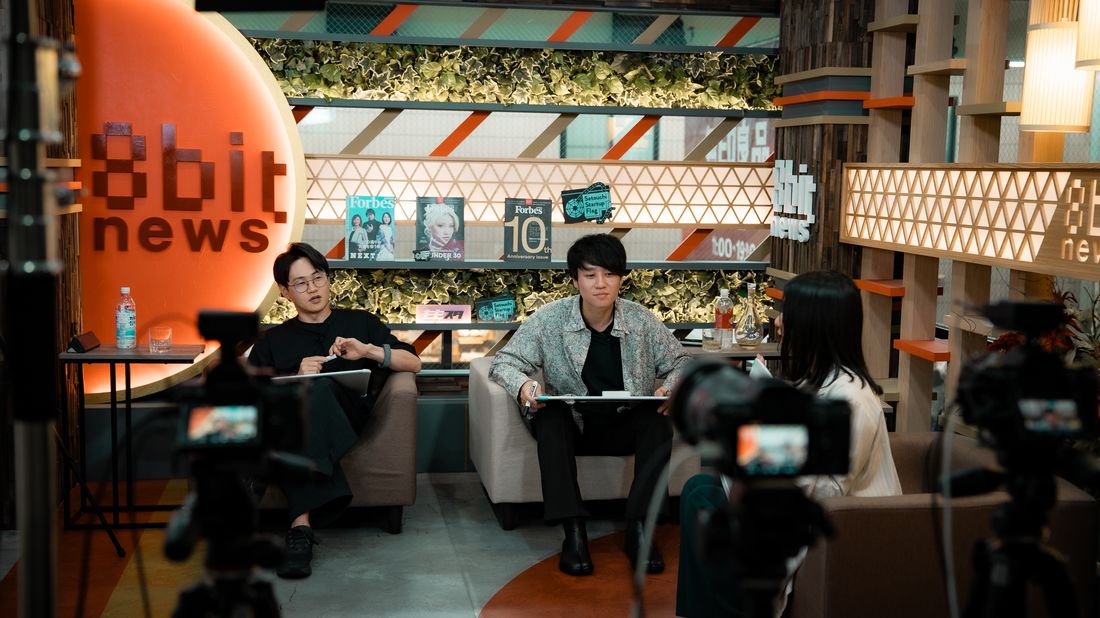
Host: On this segment of 8bitNews, we welcome a very special guest. Everyone, do you know what is currently happening in Palestine? For those who follow 8bitNews, we have provided updates at various times, but today we want to look at Palestine through a lens closer to daily life. Our guest is Chie Takahashi from “Kakehashi.” Welcome.
Guest (Chie Takahashi): Thank you for having me. I am Chie Takahashi, and I run a shop called Kakehashi. In February 2020, just as I was graduating from university, I started this as a sole proprietorship. It is a fair trade brand that delivers products made by creators in Palestine. I am now in my seventh year of involvement. Based in Osaka and the Kinki region, I travel around selling products at events and holding talk sessions about the current situation.
Host: Your website mentions the concept of “Middle Eastern Palestine meets Japanese ‘Kawaii’.” What is the story behind this, especially as a fair trade brand?
Guest (Chie Takahashi): It goes back to my original experience with Palestine. I visited there in 2018. When I told people in Japan that I wanted to go or had been there, the reactions were often negative—people thought it was dangerous or wondered why I would go. I felt there was a lack of accessible entry points for people in Japan to connect with Palestine. This photo is from 2018 when I stayed with a host family in Hebron, known locally as Al-Khalil, in the West Bank.
Host: That is a wonderful photo. I also went to Gaza in 2017 with the Japan International Volunteer Center (JVC). I remember the hospitality; even during blackouts, the head of the household would welcome us, expressing respect for Japan’s post-war economic recovery. Yet, when I returned to Japan, the reaction was often, “Where is that? That sounds tough,” which was a stark contrast. What kind of conversations did you have during your homestay?
Guest (Chie Takahashi): Since I was a student, we talked about everyday things. As a woman, I spent most of my time with the women of the family. We talked about makeup, K-pop, and what was trending among middle and high schoolers. They taught me how to dance and some Arabic. I initially went because I was studying cultural anthropology and was interested in cultures different from my own. I knew about the “Palestine issue” from books, but I wanted to see it for myself.
Host: What were your impressions once you were there?
Guest (Chie Takahashi): I was struck by the vibrancy of daily life—the colors of the town, the many small shops, and the number of children. The streets were bright late into the night. But within that daily life, stories of the occupation would slip into the conversation naturally. My host family’s original home had been destroyed, and they were living in their second home. You see the wall and pass through military checkpoints. It became personal to me. I realized that if I wanted to make supporting Palestine my life’s work, I couldn’t do it as a typical employee. I had to create the environment myself, which led to starting Kakehashi.
Host: You brought some items today. This sign says “Palestine General Store Kakehashi.” And you are wearing a beautiful garment.
Guest (Chie Takahashi): Yes, I bought this in the West Bank in the summer of 2023. I went to a flea market with Aisha, the designer we are supporting. This brooch is also a fair trade product made by our producers. This bag was made by Aisha. It’s a one-of-a-kind piece. We also have olive wood coasters, pens, and small spoons.
Host: Tell us more about the producer, Aisha.
Guest (Chie Takahashi): I first connected with her online in 2020, right before the pandemic. She is based near Nablus. We have a video from the crowdfunding site where she speaks about her situation.
Aisha: My vision for Aisha Design is to have an independent base. Currently, I work from a small corner of my home. To continue my work and escape the pressures around us, we need our own place. I want to create employment opportunities for other women and make this project sustainable. We have continued through many difficulties, but the biggest challenge is the lack of a workspace. I work from home under a lot of pressure, both familial and external. Sometimes I can’t finish orders because I don’t have the space to organize materials. Since October 7th, 2023, I have been psychologically devastated. The economic and social pressures have doubled. I thought about quitting many times because it was so exhausting. We lost customers and had no income for two years. I almost fell into depression. I tried to rent a studio twice, but the rent skyrocketed because of the attacks. We really need support to get a dedicated base so we can produce consistently and employ more women. I love my designs and I want to keep going despite the hardships.
Guest (Chie Takahashi): As she mentioned, the situation has worsened. Traveling from Nablus to Ramallah, which used to take an hour, can now take six hours one way because of checkpoints. Sometimes she spends 12 hours on the road not knowing if the gates will open. Aisha specializes in upcycling. Nablus has many furniture and clothing factories. She takes the large scraps that would otherwise be thrown away and uses them as the base for her designs, adding traditional embroidery.
Host: The crowdfunding goal is 1.5 million yen. With the weak yen and inflation, that must be a tight budget.
Guest (Chie Takahashi): It is. The cost of materials and shipping is unpredictable. If we exceed the goal, we will set a next goal. The rewards include stickers with art inspired by Palestine, vegan cookies made with Palestinian olive oil from a shop in Awaji Island, and organic coffee from a roastery in Kyoto. We also have meal vouchers for Palestinian restaurants in Tokyo and Osaka.
Host: It’s about “co-existence” (kyōzaikan). Not just feeling sorry for someone far away, but feeling that we are existing together. By supporting this, we can touch these beautiful products and feel connected to Aisha as she continues her work.
Guest (Chie Takahashi): Exactly. I want people to see the richness of Palestinian life, not just the tragedy. We need to be persistent and not give up. I hope people can connect through these various entry points.
Host: The campaign runs until September 30th. Please support them if you can. Thank you, Chie Takahashi.